

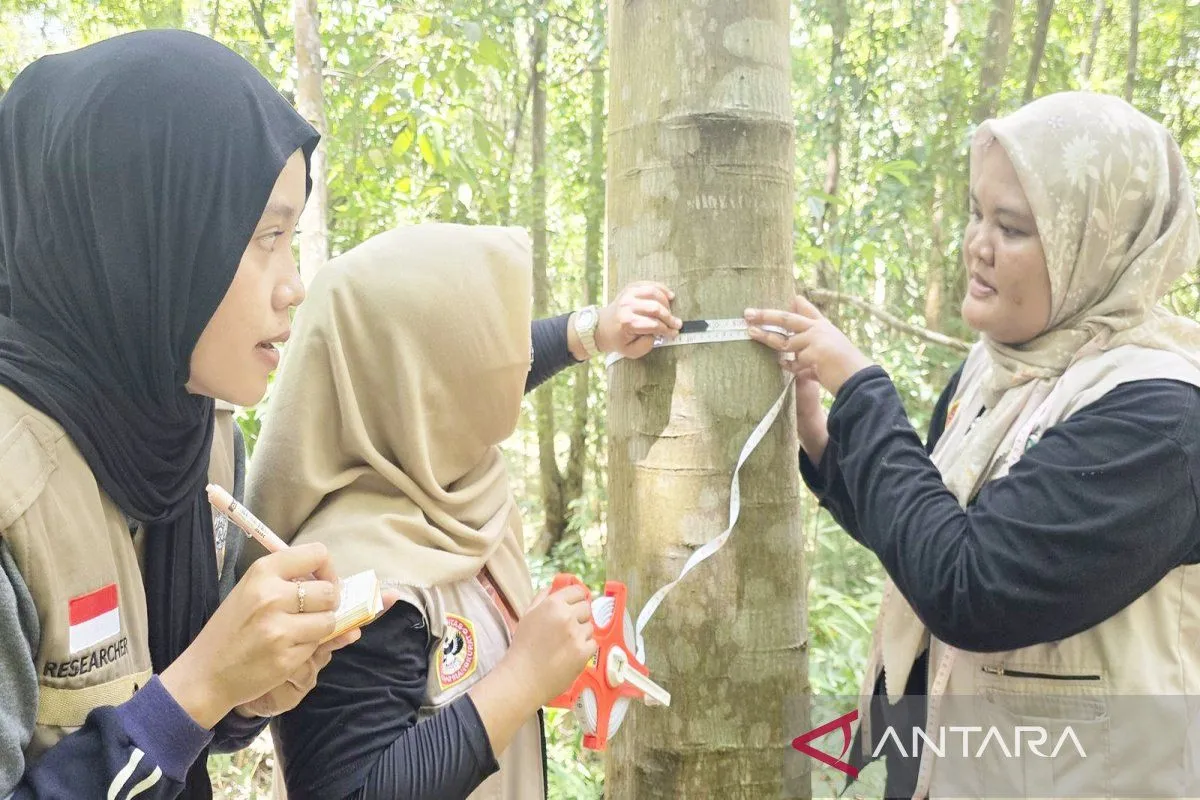
Banjarmasin, S Kalimatan (ANTARA) - Lambung Mangkurat University's (ULM's) biodiversity observation team has discovered the rare "saninten" tree (Castanopsis argentea) or often called forest rambutan in the tropical rainforest of Biodiversity Park in Manjai Hill Valley, Banjar District, South Kalimantan.
"Saninten is a native Indonesian tree which is nearly thought to be gone, and some areas have even declared locally extinct," said head of the team, Luthfiana Nurtamara, M.Pd in Banjarmasin, Friday.
She said International Union for Conservation of Nature (IUCN) listed saninten as endangered species on the Red List.
Read also: Giant ants inhabit South Kalimantan's Bukit Manjai Biodiversity Park
The botany lecturer at the ULM Biology Education expressed her gratitude that saninten was finally found in the Biodiversity Park. She committed that her team will preserve it in the wild.
Dr Amalia Rezeki, a conservation biologist at the ULM, and founder of the Biodiversity Park, expressed her delight at the discovery of the rare saninten in the area she manages as a research and conservation center for tropical rainforest ecosystems.
"This is good news for us, especially since this tree is rare and protected," she said.
She explained that the Conservation Strategy and Action Plan (SRAK) document has designated 12 priority tree species for conservation efforts, including the saninten tree.
Read also: ULM conservation expert increases giant freshwater prawns population in Barito waters
According to Minister of Environment and Forestry Regulation No. P.106/MENLHK/SETJENKUM.1/6/2018 concerning Protected Plant and Animal Species, the Castanopsis argentea species is the only Castanopsis genus protected nationally.
The saninten tree only bears fruit once every two years, making natural seedlings of this tree extremely difficult to find in the wild.
Following up on this discovery, she said she will implement conservation efforts by protecting and caring for it and propagating it to ensure its preservation and sustainability.
Amel explained that the saninten can grow up to 35-40 m tall. It has a black, cylindrical stem. Its leaves are elongated, pointed, and measure 7-12 cm long and 2-3.5 cm wide.
Its primary habitat is in the forests of hilly and mountainous areas at elevation of 150 to 1,750 meters above sea level, such as in Manjai Hill valley which is 100-340 meters high.


